
News

Sculpting Sovereignty: Why Luxury Wearable Art Is Redefining the Avant-Garde Closet
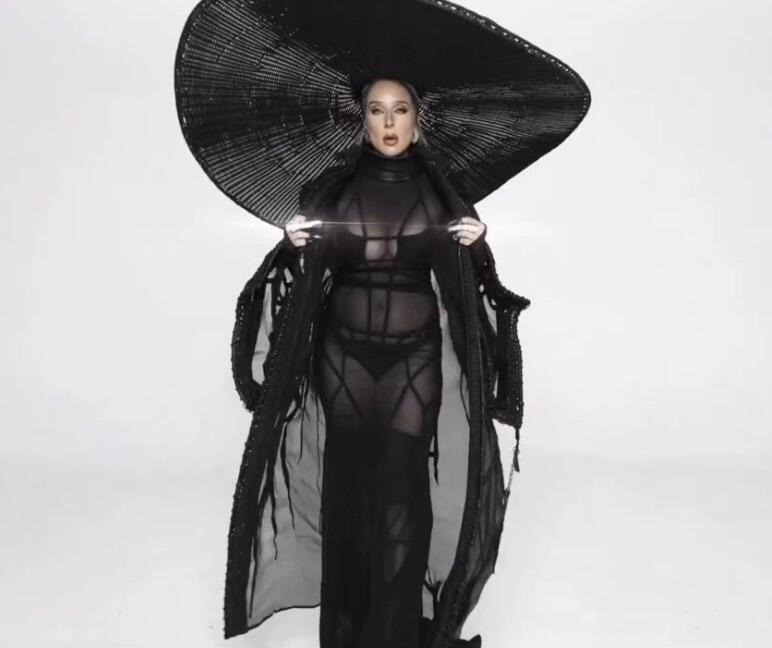
A garment can hold a body the way a sculpture holds its form. That's the premise behind Gelareh Designs, and that’s why the brand calls its work luxury wearable art, not clothing.
Gelareh Alam didn't arrive at this by accident. She grew up in Iran under strict censorship, where fabric and form became a quiet, coded language. San Francisco gave her something different: room to make work without asking permission. As a sculptor and painter first, she still designs the way she sculpts, building outward from the body instead of draping over it.
That instinct shows up in every piece as sculptural armor: distressed wool, premium Lycra, hand-shaped leather, fitted close like a second skin. It's luxury wearable art with a structural agenda, a philosophy woven into every piece across the brand's complete avant-garde collections.
Table of Contents |
How Avant-Garde Fashion Transforms Clothing Into Wearable Art
Avant-garde fashion rejects the flat, automated patterns that dominate mass production. Gelareh Designs builds outward from the body instead, drawing on dimensional, organic geometries.
Skeletal bone structures inform seam placement. Volcanic fissures inspire the cracked, layered textures across bodices. Cosmic fields shape the asymmetry of entire silhouettes.
This is a slow-fashion house by design, not by marketing copy. Every piece is bespoke and made to order, which eliminates the waste baked into mass manufacturing and protects the integrity of the original sketch.
Why Luxury Wearable Art Requires Bespoke Craftsmanship
-
Manual fabric texturing, done by hand, piece by piece
-
Intricate hand-embroidery layered across structural panels
-
Custom metalwork shaped specifically for each silhouette
-
Tailored pattern adjustments unique to the individual client
None of this happens on a factory line. A single coat can take weeks because the leather paneling is cut, scored, and shaped by hand before a single seam is sewn. The metalwork is forged, not stamped, which is why no two clasps sit identically against the body.
This is the operational backbone of avant-garde fashion at this level: labor-intensive, irregular by intention, and resistant to shortcuts. This uncompromising, labor-intensive engineering is precisely why the garments can survive the earth's most hostile, unforgiving environments.
Why Premium Burning Man Fashion Demands Performance and Durability
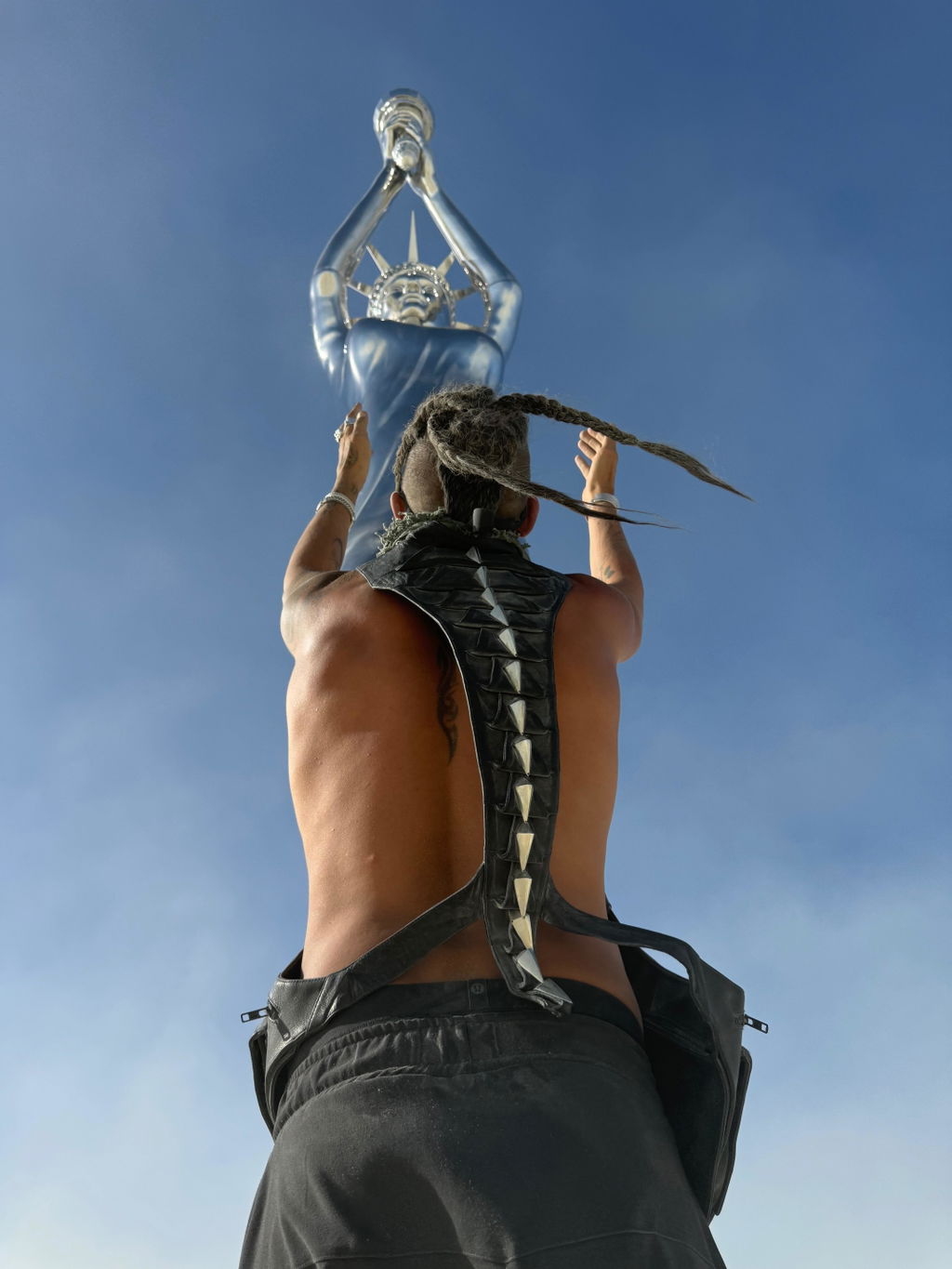
Black Rock City does not forgive bad construction. The alkaline dust is abrasive, the wind is relentless, and a garment built for ordinary Burning Man fashion can fail within hours on the playa.
Premium Burning Man fashion has to survive conditions that would shred a typical statement piece. Gelareh Designs treats this as an engineering problem first, a visual one second.
The Galactic Guardian, one of the brand's modular silhouettes, transforms from a structured jacket into a dramatic flowing cape without sacrificing wearability across a twelve-hour day in the desert.
Key Features of Premium Burning Man Fashion Outerwear
-
Deep-pocket implementations sized for real desert essentials
-
Heavy-duty closures that withstand repeated wear and abrasion
-
High-quality internal breathable linings for comfort during extended use
-
Reinforced seams along stress points to prevent dust-related tearing
These modular layers are built precisely for that environment, engineered to hold their form throughout the entire burn cycle as high-performance architectural outerwear.
This is where luxury wearable art earns its second word. Art that cannot survive its own environment is decoration, and decoration is not the business Gelareh Designs is in. But the brutal elements of the playa are not the only stage where this physical armor commands absolute authority.
Luxury Wearable Art in Film and Television Costume Design
The brand's dark fantasy aesthetic has moved well beyond retail. Gelareh Designs has built pieces for film/television costume design work on productions that demand a very specific visual language.
On Star Trek: Discovery, the brand contributed highly geometric, otherworldly lines for futuristic star-beings, where every angle had to read as alien rather than costumed.
On Lucifer, the work shifted toward sleek, commanding leather silhouettes designed to convey systemic power on screen. On Black Lightning, graphic, sharp-edged armor was engineered specifically to translate cleanly in high-definition broadcast.
This same aesthetic has reached the stage. Lady Gaga, Jared Leto, and FKA Twigs have all worn Gelareh Designs pieces for live performance, where structural armor functions as both costume and amplifier.
Film/television costume design and concert wardrobe demand the same thing: garments that hold their geometry under harsh lighting and constant movement. The same engineering standard applies to every retail piece the brand produces.
Why Collectors Choose Luxury Wearable Art
Choosing a bespoke piece from this house is a quiet act of devotion. It is devotion to individual sovereignty, to slow-fashion integrity, and to the idea that clothing can carry intention rather than just fabric.
To ensure an exact anatomical fit, first-time buyers can utilize the brand's personal measurement care service prior to placing an order. It is the surest way to receive a piece engineered specifically for one's body.
Frequently Asked Questions
How does the made-to-order sizing process work?
After purchase, the customer service team contacts every buyer directly to collect detailed chest, waist, and silhouette measurements. This step bypasses the sizing errors common with off-the-rack garments.
What materials are used in these structural garments?
Gelareh Designs avoids cheap synthetic fillers entirely. Every piece is built from high-grade natural wool, cotton, custom-treated leather, and flexible lycra, chosen for durability and movement.
How does international shipping and payment work?
The brand offers free worldwide shipping on all orders. Shop Pay integration also allows customers to split payments into secure, flexible installments at checkout.
Is luxury wearable art suitable for everyday wear or only for events?
Many pieces, particularly the modular outerwear, are engineered for repeated daily use. The same construction standard built for film/television costume design performs well in ordinary urban environments.

From Concept to Couture: The Zero-Waste Journey of Handmade Luxury Fashion
The handmade luxury fashion industry loves the word "couture." It appears on labels, in lookbooks, across brand stories written by people who have never even watched an artisan spend four hours on a single seam. At Gelareh Designs, the word earns its place - because the journey from concept to couture is not a metaphor. It is a literal, unhurried, zero-waste process that begins only when you decide it should.
That philosophy came directly from founder Gelareh Alam, a designer whose path to fashion ran through conflict, displacement, and the kind of silencing that can only be answered through art. When she built this San Francisco atelier, she wasn't entering an industry. She was correcting one.
Here’s how that philosophy translates into every garment we make.
Table of Contents |
One Atelier. One Artisan. One Garment.
Walk into most places that call themselves luxury brands, and you'll find a supply chain - factories, subcontractors, and warehouses stacked with pre-cut fabric waiting to become something. At Gelareh, none of that exists.
Every piece is crafted by a single master artisan in our in-house atelier, from the first cut to the final stitch. One person. One garment. One sustained act of attention that cannot be replicated by a production floor or accelerated by a deadline.
The needle doesn't move until you place your order. That's not a poetic claim. It's how we operate - and it's what separates genuine handmade luxury fashion from bulk manufacturing.
The Fabrics That Refuse to Be Ordinary
We choose each fabric with the same deliberateness as the garment itself. Nothing is background. Everything is character.
-
Leather - sculpted, molded, and tooled entirely by hand. Our leather statement pieces are built to age into authority, deepening with wear rather than diminishing from it.
-
Leather harness fashion constructions - pieces that sit between garment and sculpture, channeling strength and restraint into something worn as pure assertion.
-
Metallic & structural fabrics - worked and manipulated for hours to achieve the precise drape, tension, and silhouette the design demands.
-
Silk, suede & lace - introduced where strength needs fragility as its counterpoint, creating the juxtaposition that defines the Gelareh aesthetic.
Our handcrafted leather fashion is among the most technically demanding work we produce. Leather doesn't forgive mistakes - every incision is permanent, every seam a record of the hand behind it.
Made-to-Order Is the Zero-Waste Strategy
The fashion industry generates staggering amounts of textile waste every year - and the mechanism is straightforward: brands produce more than they sell, and the excess gets warehoused, discounted, or destroyed. The root cause is anticipation without responsibility.
We have never operated this way. Not because of a sustainability initiative, but because producing without purpose has never been compatible with what we believe a garment should be.
Every piece at Gelareh is made to order - not to scale production, but to preserve intention. When you place an order, you are not selecting from existing inventory. You are initiating the existence of something that would not otherwise exist. The fabric is sourced for your piece. The artisan's time is devoted to your piece. Nothing is made speculatively, nothing sits in a warehouse, and nothing is ever destroyed at the end of a season.
Built Around You, Not a Size Chart
Standard sizing is a system designed for producers, not for people. It assumes a statistical average and implicitly tells everyone outside it that luxury wasn't made for them. We find that unacceptable.
Our bespoke tailoring option allows up to 30% of a garment's construction to be re-engineered around your exact measurements - your posture, your proportions, the specific way your body moves. This isn't an alteration. It is building the garment's architecture outward from you as the blueprint.
Worn at the Grammys. Housed in the Smithsonian.
There is a persistent assumption that handmade and slow mean marginal. Gelareh Designs disproves it quietly and completely.
Our work has been exhibited at the Smithsonian American Art Museum, the Cincinnati Art Museum, and the Oakland Museum of California. Our leather statement pieces and structural garments have appeared at the COP28 Sustainable Fashion Summit, on stage during a live Prince performance, and in productions including Star Trek: Discovery, Lucifer, and Gotham.
These aren't partnerships pursued for credibility. They are recognitions of what the work already is - art that holds cultural weight precisely because it was made by hand, with intention, for a specific person or moment. In a world of machine-perfect uniformity, that is increasingly rare and increasingly powerful.

Most People Wear Clothing - A Few Wear Conviction
We have no limited-time offer. No seasonal pressure designed to make last month's purchase feel like a mistake. What we make doesn't work that way, and neither do the people who wear it.
If you've read this far, you already understand the difference between a garment that was manufactured and one that was made. Between something pulled from inventory and something that didn't exist until you asked for it. Between clothing and handmade luxury fashion that was built, specifically, deliberately, completely, for you.
The next step is yours. Begin your custom order at Gelareh Designs today.
Frequently Asked Questions
How long does a made-to-order piece take?
Each creation is developed with care, precision, and attention to detail. The timeline reflects the depth of craftsmanship involved. These are not pieces made for speed, but for longevity, crafted thoughtfully so that what you receive is truly worth waiting for.
Can Gelareh work for non-standard sizing?
Yes, this is exactly what our bespoke option exists for. We re-engineer proportions and structural placements around your body, not a size template. Reach out, and we'll walk you through the process.
What makes your zero-waste approach different?
We don't overproduce and then offset. We simply don't produce until there's an order. It's the most honest form of sustainable fashion.
How do I care for a leather or structural piece?
Store on a wide-shoulder hanger, condition leather annually, and keep pieces away from direct sunlight. For metallic and structural fabrics, dry clean only. When in doubt, contact us directly; we're always happy to advise.

How a Film Costume Designer Blends Cultural History With Future Lore
Every costume ever worn on screen carries two timelines: the world it came from and the world it is pointing toward. That tension - between memory and imagination, between the archaeological and the prophetic - is precisely what makes the work of a film costume designer so extraordinary.
They are not simply dressing actors. They are building civilizations.
A coat catches the light. A silhouette tells us something about a character before they speak a single word. A texture suggests an entire culture's relationship with the earth. None of that happens by accident. It happens because a costume designer has done the kind of research most people associate with historians and world-builders, then translated it into something a human body can wear.
At Gelareh Designs, this intersection is the foundation of everything we create, from our collections to the custom costumes we craft for film and television productions.
|
Table of Contents |
The Research Comes First - Always
Before a single sketch is drawn, a serious film costume designer is buried in research. Not just fashion history, but cultural history in the fullest sense.
This includes:
-
Mythology and ancient belief systems
-
Textile and weaving traditions across civilizations
-
Warrior armor and protective dress
-
Ceremonial and ritual garments
-
How cultures expressed status, grief, power, and faith through clothing
This research phase can last weeks or months. A designer working on a fantasy epic might study ancient Mesopotamian court dress, West African kente weaving traditions, and Mongolian nomadic armor simultaneously, before deciding what a single character should wear.
The goal is not to copy these traditions. The goal is to understand the emotional and social logic behind them, so that logic can be applied to a world that does not yet exist.

Cultural Accuracy as Emotional Truth
There is a meaningful difference between costumes that reference a culture and costumes that honor it. The film industry has not always gotten this right. But the best costume designers understand that cultural accuracy is not just an ethical responsibility. It is a creative advantage.
When a costume is built on genuine cultural understanding, audiences feel it even if they cannot explain why. Something reads as real.
Two examples that show this clearly:
Black Panther — Ruth E. Carter spent years researching pan-African textile and fashion traditions before designing Wakanda's visual world. The history was real even when the setting was not.
Dune — Jacqueline West pulled from Bedouin, Tuareg, and Central Asian dress codes to make an alien desert planet feel inhabited and ancient. Cultural depth made fiction feel lived-in.
In both cases, the designer's research gave the world its authenticity.
Building Future Lore From Historical DNA
Here is the paradox that every great costume designer for film eventually confronts:
The future, on screen, is almost always built from the bones of the past.
Science fiction and fantasy costumes that feel genuinely new are never built from nothing. They are constructed by taking historical references and distorting them, stretching them, recombining them in ways that feel both familiar and completely alien.
Consider how this works in practice:
-
A medieval breastplate becomes the architecture for a starship officer's uniform
-
The geometry of Aztec stonework becomes the surface texture of a villain's armor
-
Persian miniature painting informs the embroidery on a queen's ceremonial coat
None of this is visible to the average viewer, but all of it is felt. The costume carries memory, and that memory makes the fictional world feel real.
This is what we think about when designing our own collections. Names like Arcturian, Starborn, Lemurian, and Incarnate Code reflect a design philosophy rooted in exactly this tension, drawing on ancient and mythological archetypes to build something that feels otherworldly and deeply human at the same time.
Where Wearable Art and Film Costume Design Converge
There has always been a natural kinship between wearable art and film costume design. Both disciplines demand the same thing: that clothing carry meaning beyond aesthetics.
Designer movie costumes for high-concept productions are rarely about seasonal fashion. They are about:
-
Identity
-
Transformation
-
Power
-
Story
These are exactly the values that drive serious wearable art labels, and the reason why designers who operate outside the trend cycle are increasingly being called into film work.
Gelareh Designs has dressed productions including Gotham, Lucifer, Star Trek: Discovery, and Black Lightning. Not because we chased film work, but because the pieces we were already creating spoke the same language those productions needed.
Sculptural. Armored. Emotionally charged. Built to say something about the person wearing them before a single line of dialogue is delivered.
That is the heart of what a film costume designer does, and it is also the heart of what we do.
Why This Matters in 2026
Cinema has quietly become one of fashion's most powerful forces.
What characters wear on screen moves directly into how people want to dress in real life, faster than ever before. A coat from a film enters the cultural conversation before the movie even reaches cinemas.
The best film costume designers are now operating as cultural architects, not responding to trends but setting them, often years in advance. And audiences feel this shift:
-
People are absorbing visual worlds, not just watching stories
-
They want to know where fabrics came from and how silhouettes were built
-
The craft that was once invisible is now something people actively seek out
For designers whose work is handcrafted, narrative-driven, and made with intention, this moment feels like a recognition that was a long time coming.
The Relic of a World That Has Not Happened Yet
There is a phrase we return to often:
A costume is a relic of a world that has not happened yet.
The best film costume designers understand this instinctively. They are time travelers, moving between the archive and the imagination, borrowing from civilizations that existed and projecting forward to civilizations that might.
When they get it right, the garment carries both timelines inside it. You feel the weight of history and the pull of the future simultaneously.
That is what we aspire to at Gelareh Designs, in every collection and in every piece of custom movie costumes we create.
Interested in working with us on a production? Explore our costume design services.
Frequently Asked Questions
What does a film costume designer actually do?
A film costume designer researches, conceives, and creates every garment worn on screen. They work closely with directors, study character psychology, and often build custom pieces from scratch, going far beyond simple wardrobe selection.
How does cultural history influence costume design in film?
Designers draw from real civilizations, mythology, and textile traditions to build authentic visual worlds. Even in fantasy settings, that cultural grounding is what makes a fictional world feel emotionally real and inhabited.
What is the difference between a costume designer and a wardrobe stylist?
A costume designer builds original garments around a character's story arc. A wardrobe stylist selects from existing clothing. One creates; the other curates. The creative scope and narrative intention are fundamentally different.
Why are fashion designers increasingly crossing into film costume work?
Wearable art designers already think in narrative, identity, and transformation, which is exactly what costume design for film demands. Their work exists outside trend cycles and carries the kind of symbolic weight productions need.